Fidgets are more than fun
By: Erin Young
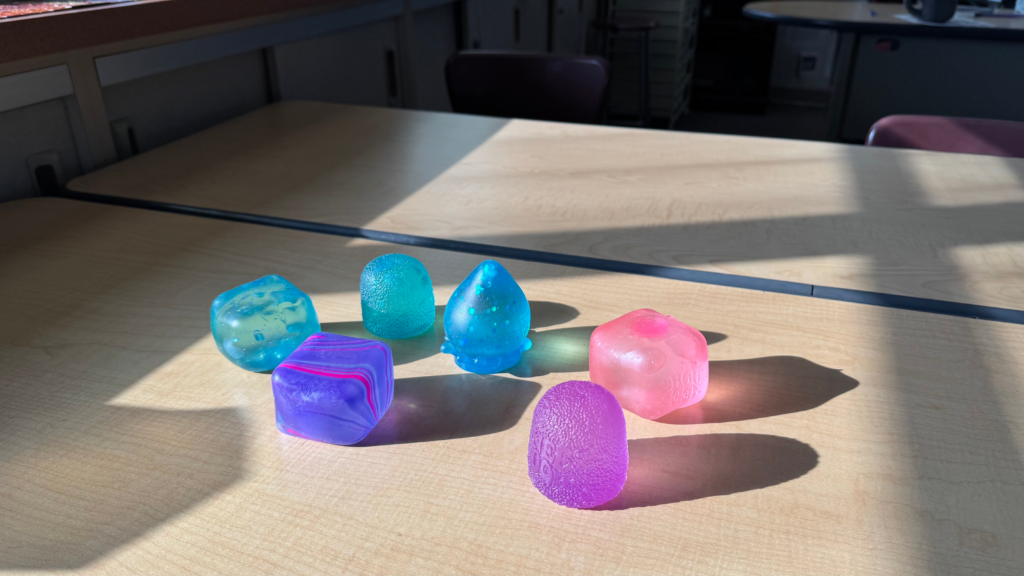
School can be hectic, life can be stressful, and sometimes we need help with managing it all. Fidgets are small tools for students, adults, and kids to help them focus and mindfully relieve stress. These can be small stress balls such as “Needohs” or a reusable bubble sheet like “Pop-Its”.
The battle to listen to teachers, get work done on time, and do it all well takes a toll on the mind and body. Fidgeting with a Needoh or popping a Pop-It keeps your mind focused while your body gets to move.
According to Orchid Pediatrics, “For many children—especially those with ADHD—the more they move, the better they focus. Fidgets allow children with hyperactive bodies to keep moving in a subtle, non-disruptive way, so they can stay focused on whatever task is at hand.” Children who ‘play’ during class are just trying to regulate their bodies, not disrupt the class.
Other than helping kids focus, fidgets can help boost children’s creativity. A boost in creativity and focus leads to a more efficient, well-rounded student. Teachers should urge students to find solutions to help them regulate their bodies so they can perform their best. It is not a distraction; it is a tool.
Although fidgets help focus and creativity, it can also help students improve their overall emotions. “In a 2006 study, students who used stress balls showed improvements in attitude, attention, writing, and peer interaction,” from Orchid Pediatrics.
These fidgets are helping social interactions as well, and for many kids, these interactions are hard enough. These tools are giving students help where teachers and parents cannot.
Fidgets are not toys, not distractions, and not something that should cause disruption. With the right intentions, fidgets can bring a whole new world of possibilities and achievements to those who may need a little extra help in the classroom and beyond.
Fidgets: more toy than tool
By: Maddie Derks
School can be stressful and, at times, overwhelming; life in general can be too, but it’s important to limit distractions in everyday life to ensure success. In recent years, students of all ages have turned to fidget toys to help with focus and concentration. Unfortunately, they have quickly become a distraction in the classroom as well as a health hazard.
Instead of promoting focus, these fidget toys are increasing the distraction they are supposed to be keeping at bay.
“Fidget toys can be a distraction from tasks that need to be completed in the present moment,” said teacher Dillion Ristucci.
Students often trade and share their fidget toys, passing them around the classroom, not paying attention to the lesson. They are not only distracting themselves, but also the students around them, taking away many learning opportunities in the process. Fidget toys started as a tool to manage attention, though they morphed into quite the opposite; instead of providing focus, they have created the ultimate distraction.
Additionally, the chemical components that make up certain fidget toys can be detrimental to the health of the student. Needoh is a commonly manipulated fidget; however, the gel inside the toy contains a low PH level similar to what is found in lemon juice or vinegar.
Dr. Danilo Del Campo of the American Academy of Dermatology sees this as a problem.
“When the pH is too extreme, either too low or too high, that’s definitely a problem,” Del Campo said in the article “Fidget Toys Can Be a Sticky Mess – or Worse. “On kids, that’s going to be more pronounced. They’re more prone to irritation because their skin isn’t as thick, and their immune systems aren’t as robust, so they’re more likely to have these reactions.”
Recently, social media sites like Instagram and Tik Tok contain videos encouraging people to put the gel-filled fidgets in the microwave to make them softer. This can lead to harmful consequences.
Consumer Reports safety experts tested the impact of microwaving the toys and discovered that “some of the toys exploded after only about 15 seconds in the microwave—and reached over 200° F in that short time. At that high heat, contact with the skin would cause immediate tissue damage.”
Due to the potential harmful repercussions as well as the disruption of the learning environment for both the user as well as other students, it can only be considered a hindrance rather than a beneficial tool.
Authors


Subscribe to our newsletter for more!